 Goal: Provide people in crisis and their families with the right care at the right time in the right place through Wisconsin’s Crisis System.
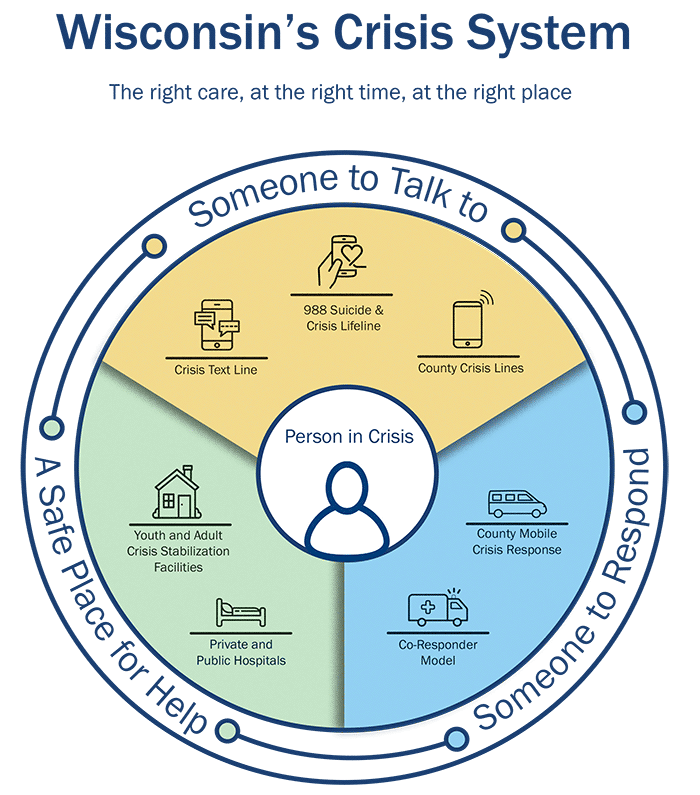
Objective: Promote and expand the continuum of crisis services embedded within the broader behavioral health system to provide care in the most effective and least restrictive way possible by providing people in crisis with someone to contact, someone to respond, and a safe place for help.
 Action Steps:
Someone to contact:
- Promote the 988 Suicide & Crisis Lifeline, a national initiative that provides support to people in a mental health or substance use crisis. Wisconsin’s 988 center is the Wisconsin Lifeline, which has over 80 counselors who answer and resolve several thousand calls, chats, and texts each month.
- Promote the Crisis Text Line, a nationwide network of trained volunteers that provide immediate crisis support by text. Wisconsin’s Crisis Text Line partner is the HOPELINE.
- Raise awareness of county crisis lines. Certified crisis programs have crisis lines staffed by mental health professionals and trained volunteers. They assist with problem-solving stressful situations and determining whether an individual can remain safely in the community. They can help identify community-based outpatient, as well as inpatient, resources for people in crisis.
Someone to respond:
- Expand mobile crisis response. Mobile crisis is an in-person response to an individual in crisis. A service provider or a team of responders will assist in de-escalation of the crisis and provide support and linkage to additional services.
- Encourage co-responder mobile crisis models. Some communities use co-responder models that pair a mental health professional with law enforcement, emergency medical services, or other first responders to provide in-person support to people in crisis.
A safe place for help:
- Support crisis stabilization facilities for adults and youth that offer 24/7 crisis stabilization services in a non-hospital setting. Stays are arranged through the county.
- Develop additional facility-based crisis care options:
- Crisis Urgent Care and Observation Facilities, also called Crisis Care Facilities (CCFs), are currently in development and will be designed to provide immediate crisis intervention services 24/7 to people with mental health or substance use needs.
- Crisis hostel programs are currently in development and will be designed to provide crisis stabilization support to people for a period of 23 hours or less.