 Goal: Expand access to peer support.
Peer support refers to a form of care within a relationship of equals that is grounded in mutuality, strengths-based approaches, and the belief in each person’s right to self-determination. In this context, a peer is someone who has their own experience navigating thoughts of suicide, or other mental health and substance use challenges. The connection and validation provided through peer support can be a protective factor for those experiencing thoughts of suicide.
 Objective: Support the development of new and existing initiatives to facilitate access to non-clinical care and support outside medical offices and hospitals.
Action Steps:
1. Educate about the peer support workforce, ethics and principles.
2. Support the integration of peer services into the broader continuum of care through training and technical assistance for health and crisis systems—with emphasis on maintaining the distinct role of peer support as a voluntary intervention that does not participate in coerced or forced treatment.
3. Create confidential, peer-led spaces for the expression and exploration of all emotions, without judgment or clinical processes.
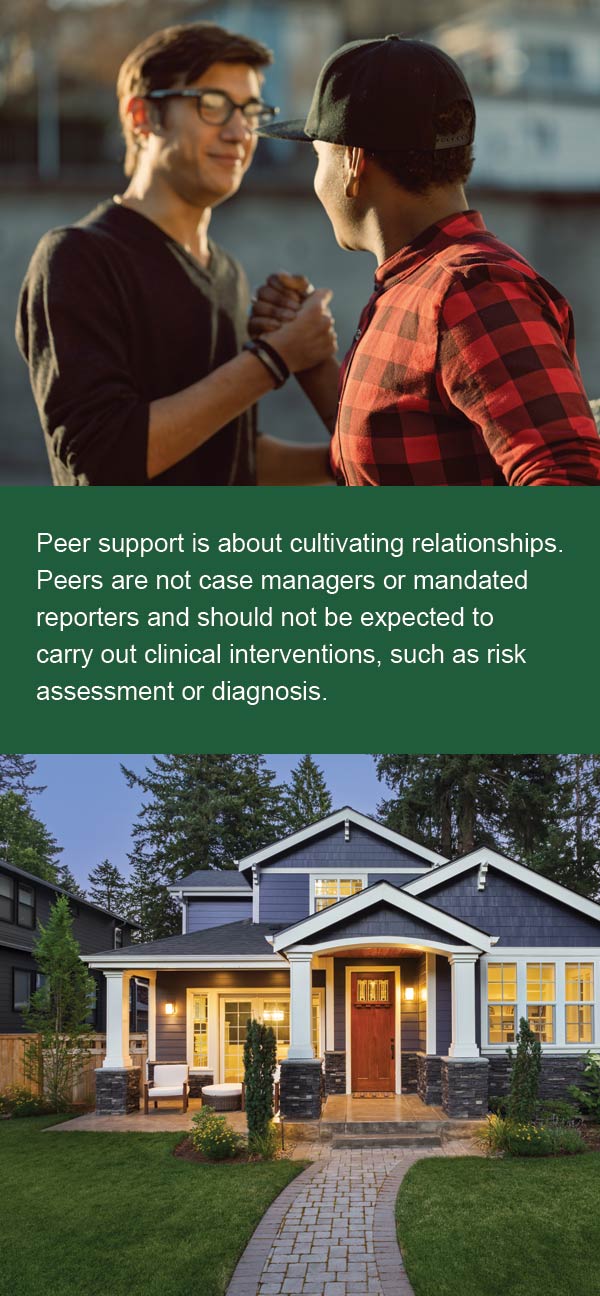
4. Sustain and expand availability of peer-run respites, where people can go in times of increased stress or symptoms of mental health and substance use concerns. Peer-run respites offer short-term stay in a non-clinical, homelike environment to receive support from those who have faced similar challenges. Similarly, peer recovery centers are a space for connection, activities, and education provided on a drop-in basis during their open hours.
5. Sustain and expand availability of virtual peer support programs, like warmlines, that can provide emotional support and connection to those struggling with mental health, substance use, or social isolation.
6. Include peer support roles as essential team members in any suicide prevention or recovery program. Offer competitive pay and benefits for peer roles.
7. Invest in peer support workforce pipelines, including training, mentorship, certification (when aligned with peer values), and leadership development for underserved and marginalized populations.
8. Develop peer support programs tailored to culturally specific needs—not only for LGBTQ+, Veterans, and BIPOC, but also for disabled communities, immigrants/refugees, people with language barriers, and formerly incarcerated individuals.
9. Increase research on outcomes of peer support using participatory methods that center lived experience, avoid pathologizing frameworks, and reflect peer values (e.g., healing, connection, autonomy).
Alternatives to Suicide (Alt2Su) is one example of a peer support group that creates opportunity for connection and validation around thoughts of suicide. Participants share their struggles and successes, provide support for one another, and strategize alternatives to help each other best cope with difficult life circumstances. The Wildflower Alliance, a grassroots peer support, advocacy, and training organization developed the Alt2Sh framework.
Community Living Rooms are pop-up, community-based spaces for people seeking social connection and emotional support. Each Community Living Room includes 2-3 trained listeners with experience in Emotional CPR, and includes activities based on community needs, such as a shared meal or arts and crafts.